
A Place Of Memory

-
This transcript was generated using a combination of speech recognition software and human transcribers, and may contain errors. Please check the corresponding audio before quoting in print.
(meditative music)
DREW SHUPTAR-RAYVIS/BLACK CORN: So I'm a citizen of the Pocomoke Indian Nation. Daniel is Nause-Waiwash who are Choptank and Nanticoke people. We're sister communities, so we've always shared bordered homelands for time immemorial—
DANIEL ABBOTT/FIREHAWK: Yeah.
DREW:—and likely going back before contact.
DANIEL: I think it takes a community of support and respect to develop a nation,
DREW: Right.
DANIEL: And maintain a nation. There are over 500 nations of native people throughout the Americas—
DREW: And that’s just an estimate,
DANIEL: —when Europeans arrived.DREW: There's probably even more.
DANIEL: Yeah. You have family units called clans that come together and and they build villages and and then you have matriarchs, clan mothers. They're part of the chiefs council. You have some tribes, you have white chiefs, you have red chiefs handle internal external matters. Every village essentially is independent.
DREW: Right.
DANIEL: They have their own right to run their own lifestyle.
DREW: And a lot of these communities form into a paramounts who then they have a paramount chief that then decides for the entire—
DANIEL: (muffled) And if its larger than a cheifdom, yeah.
DREW: Each subtribe would likely probably have a clan chief and clan mother that then would go to the paramount chief—
DANIEL: A few.
DREW: —and then decide
DANIEL: I think in most of the tribes that I know there are probably 6 to 8 clans.
DREW: Oh yeah.
DANIEL: Okay. And those clans come together, they form villages, the villages then come together and form tribes. Right?
DREW: Right.
DANIEL: You might have what 10 to 50 villages in your tribe?
DREW: Right.
DANIEL: It’s not cut in stone, but somewhere in there.
DREW: Yeah. Rough. Roughly.
DANIEL: Yeah, and then the tribal elders or the tribal leaders will meet in council with other tribal leaders. So people don't understand that we had diplomats that were meeting with other native diplomats long before European arrival. Powhatan’s doing it, Unnacokasimmon doing it here on the shore, and they're forming alliances and trade and militarily and they're forming nations of tribes. Okay. And throughout the Americas, they spoke over 300 languages and over a thousand dialects of those languages. And no one had any trouble understanding one another.
DREW: Right.
DANIEL: Because you had your common language for your people that you learned, and then you had traders who covered vast distances and their trade routes overlapped, and they learned other languages. They knew many languages. And then you had interpreters in the villages that spoke several languages. And then you had on top of that sign language throughout North America, which was universal language of trade. You also had spoken regional languages of trade here from throughout the southeastern part of North America and up into the Mid-Atlantic region. You had, a spoken language of trade. Called Mobilian, Mobilian. It's things that you learn along the way. When you learn these things, you become more and more enamored
DREW: Right.
DANIEL: You know, the more you learn, it's unbelievable how advanced, how intricate the trade systems,
DREW: Oh yeah.
DANIEL: These governmental systems living and a veritable paradise. When forest like we explained, we didn't even mention the waterways—where it's written that you can look over the side of your boat and around the Chesapeake Bay region in the brackish areas, you had reefs of oysters bigger than your hand.
DREW: Yeah.
DANIEL: And even when I was young, my grandfather—I’d go out and tong for oysters and drag for crabs, run trotlines, and we would cook up oyster stews in the cabins on the work boats and steam crabs, and all kinds of good stuff. But some of those oysters, you had to cut them in thirds to get them in your mouth. Well, go to a restaurant and get oysters on the half shell, and so you have to poke 2 or 3 of them with a fork to get a mouthful nowadays, just the opposite. So the waters were so clear. It was written, you could look over the side of the boat and see 30ft to the bottom,
DREW: Right.
DANIEL: and watch the beds of eel grasses waving in the tidal currents in the bay, and all its tributaries.
DREW: Could you imagine?
DANIEL: I can’t.
DREW: I think it's I think it's just the level of beauty,
DANIEL: I can but…
DREW: I mean we can but we're traveling in our minds like, that's the thing is, just imagine seeing that firsthand. Like what it really must have made Europeans been like, you know, this this must be the Garden of Eden. Like, this must be—
DANIEL: Well they wrote that it was
DREW: Yeah.
DANIEL: And then they played it up big time—
DREW: Oh, yeah. Oh of course.
DANIEL: —to get more colonists over here, but.
DREW: But could you imagine, like, just looking down and just seeing, like, schools of fish, like, moving and swaying, you know—
DANIEL: Well, Smith, how about Smith's party, 14 on the shallop there. Can you imagine, first of all, being out on the open waters of the Bay in, June, and July, and August? (laughing)
DREW: They got a tan, that's for sure.
DANIEL: Oh they did that, and they got blown blown to hell, too, because of the storms that come up in the afternoon. The schools of fish were so huge, they literally tried to dip them up. They leaned over the side of the shallop and tried to dip them up with a frying pan.
DREW: Yeah.
DANIEL: Yeah. There were so many fish and the flocks of passenger pigeons, migratory wildfowl, so many millions of birds that they said—
DREW: Carolina parakeet.
DANIEL:—and Carolina parakeets, so numerous, so huge that some of the flocks would take off, and it literally it would take several hours to several days to.
DREW: Yeah.
DANIEL: To pass over your head. That's how large the flocks—
DREW: Well Passenger pigeons were—
DANIEL: and literally blot out the light of the sun.
DREW: And Passenger pigeons were a major food source, not only for Native American peoples, but for colonial peoples too. They are so integral to Native American peoples, there’s an Haudenosaunee song that's the “Pigeon Dance” song.
DANIEL: Squab.
DREW: Yeah, but that that literally is dedicated to the Passenger pigeon.
DANIEL: Oh, yeah.
DREW: But it's one of those things, I think, interpreting the way we do, I feel in a way it brings to life the world that was we as modern people, modern descendants of these first men. You know, in a way, by us talking like this—and I was just thinking about it—we’re bringing to life that world that was and by and we're representing it so that the public can also see it just for a moment,
DANIEL: Yes, I believe they can.
DREW: Smell it, see it, taste it. Just for a moment. For me, that is the ultimate height of interpreting. When you've when you've been able to get your audience to transport themselves just for a moment.
DANIEL: Indeed.
DREW: You know?
DANIEL: And that's best accomplished through comparing what was to what is.
DREW: Right.
DANIEL: Because people need to be able to identify and compare and contrast.
DREW: And I think going to the what is, also knowing that our communities are still here.
DANIEL: Oh yeah.
DREW: That our communities as, Pocomoke, Nause-Waiwash, Nanticoke, like we're all still here, like we were all still—we might not look the same way we did in in 1600—
DANIEL: Not after five hundred years of European contact. And I'm sure the people that were here several thousand years ago had, didn't look like—
DREW: Right.
DANIEL:—they did before peoples came in then to the Americas, because people were have been coming in to the Americas for tens of thousands of years from different continents.
DREW: You know, people, because I think one of the things here on the shore, I get all the time, people are very surprised I didn't grow up on the shore. And it's like people move, people migrate.
DANIEL: They do,
DREW: You know, especially like when we get to the middle 20th century, that's the ultimate time for people leaving ancestral homelands, and moving, and migrating, getting jobs, and like.
DANIEL: Yes, indeed, it seems to be a very cosmopolitan.
DREW: You know, so you get people my age who are in their 30s, and that's a very common thing. And I can only imagine that 40, 50 years from now, there will probably be lots of Nause Waiwash Nanticoke people born in other states,
DANIEL: Of course.
DREW: Whose ancestry or large parts of their ancestry or parts of their ancestry come back to here.
DANIEL: Well, let’s hope that they understand it and will be able to connect with their ancestors, because it's vitally important. It's something I heard and it really struck home, and that is how can you know where you're going unless you know where you came from—
DREW: Um hum.
DANIEL: —and you can fully appreciate who your ancestors were, what they accomplished, how they lived their lives, and how you became you.
DREW: Right.
DANIEL: Like I was saying when I was young, how how did I connect? Why did I connect with the natural world in the way I did before I even knew I had Native ancestry? And as soon as I found out, I went, well, that makes makes perfect sense.
DREW: Yeah, yeah. Tell me something I don't know. (laughing)
DANIEL: Yeah. And everything that I ever did in life, essentially. Well, I was fortunate enough to grow up here on the shore, which is rural, generally speaking. And I always collected fossils first, then artifacts, then leaves, then insects. And it was everything I collected everything. And that's how I became intimate with the world around me. And then I found out I'm Native. And I went, well, that makes perfect sense. I've been doing it all along, not even knowing it just it just it was part of me.
DREW: It calls to you, it calls to you.
DANIEL: It. It's it's your spirit.
DREW: Yeah.
DANIEL: Yeah. It's it's it does, you know, and it always will. And it and it will continue to I have no doubt wherever we go from here.
DREW: Right.
DANIEL: What a beautiful world we have been given by this creator. People are screwing it up, that’s—big time. There's no doubt about it. They have been for centuries. But you see, you must understand again. The creator placed us upon this Great Turtle Island, our people and others here in the Eastern Woodlands believe. And there are different stories. But basically, the creator placed us. You can ask—science can say what it wants to say as to how people came to the Americas, and when. I don't care about that, what I care about is this. And that is the creator placed us upon this Great Turtle Island called North America and gave us dominion over it and said, all that you see before you is here to make your life bountiful, and it will always be so, as long as you remember one thing, there's only one promise that you must make, and that is you will respect it. For if you cease to respect it, it will be taken from you.
DREW: Oral history in my community is one of these things that's incredibly important. It's very much a sense of identity, who we are, where we've been, where we're going. My Chief Norris Howard Sr., has taught me so much of my community's history, which, you know, he learned orally, you know, not just things that are written about in colonial records and archives, but things that he learned firsthand from his family members. I think for many of our communities on the shore, that oral history is one of these very guiding things for us. It's a backbone of who we are.
DANIEL: Indeed.
DREW: Our cultural existence, our identity to our communities, to our homelands. And that oral history is held in great reverence. It's held in great respect. But I know for me, oral history is an important thing on the Eastern Shore. You know, I something I say to people all the time is that Eastern Shore memories are long, you know, and it's very common to hear old timers talking about things that happened 65, 70 years ago, as if they had happened yesterday. Feuds with family members, feuds between neighbors that happened 70 years ago that will act as if they had happened a week ago.
DANIEL: Um hum.
DREW: And it’s, and it's a place of memory, the Eastern Shore. It's a place of memory. It's a place where ghosts and men walk hand in hand. And so for us, you know, as a Pocomoke person, our oral history is something we care deeply about. We hold it in reverence. We hold it in respect. We hold it in love. It identifies us and shapes us, and it's a part of who we are as a modern, breathing people that connects us to our historic past.
DANIEL: Well said. Very well said. In fact, I can add little to that. I will add, though, when our band of people first started doing extensive research through oral histories and state archives, county courthouse records, etc., etc., which is how you learn this and that about your people. Because birth and death certificates only go back so far. Court records are a good, good way of learning about your ancestry, but generally speaking, so little has been maintained.
And it's not always because people don't want to maintain it. You have fires, you have wars, you have records being lost. You have a lot of information disappearing over hundreds of years of colonization. And also, I do believe that at times records are being removed purposefully. And I can state through personal experience that that happened for me, where, you know, 20 years ago, the death certificate for my great-great grandfather stated, rare indeed, he was full blood Nanticoke. And we went back about ten years ago to retrieve a copy and it disappeared from the same courthouse. So other people are taking records for their own personal files, not caring about other people, which I kind of hope that isn't the case. Or they're purposefully being removed so we can't trace our ancestry back. I have no idea. I just hope that none of that is happening, but I think it does happen. I think that the fires, and the wars, and the loss of records has, has been an extreme detriment to our people tracing their ancestry. I think so little was recorded by the first colonizers to come here from Europe that we’re hard pressed from all directions to trace the ancestry.
DANIEL: The oral traditions are vitally important histories as Drew said, because Drew has grandparents still, mine have passed.
DREW: I have no grandparents left.
DANIEL: You don't?
DREW: They passed when I was—I was a child.
DANIEL: Ah, yeah, so did mine. And before I was born. Yeah, well, I was a young man. Unfortunately, I do have a tape from my grandfather in ’72, I don't know, hour and a half of the stories of the marshlands and his experiences. But I will say oral histories tell stories that connect you to the land and your ancestors. And in our case, Native people as well as European, because we're integrated.
DREW: Right?
DANIEL: We both have European and Native ancestry. In fact, there are very few Native people used to the Mississippi, except for maybe the larger nation groups such as the Iroquois, the Cherokee, some others Choctaw who maintain 100% bloodlines. You know, very, very few full blood Native people, I think, east of the Mississippi.
DREW: Yeah. And I would say as the world continues to turn, that number number will decrease, decrease, decrease, because it's antithetical to human development and human, you know, human being, you're going to spread out and marry different people. And just over time, it's just it's going to change whether you like it or not. And I think people my age, like I'm 32, you know, we're even different than our parents.
DANIEL: Yeah, indeed.
DREW: You know, like my father's Ashkenazi and Sephardic.
DANIEL: Quite a bit.
DREW: You know, my mom has Native American ancestry and colonial European ancestry and recent European ancestry. So, I mean, I think even people my age are going to be different than people your age. And then, you know, my children, or there, you know, and they're going to have a different ancestry than what I will have, you know. So I think it's always in the constant flux of change. What I think is important is that this oral history connects us and it binds us.
DANIEL: It does.
DREW: And it's one of these things that when the records fail, the oral history is kind—it upholds., you know, and it’s—
DANIEL: It's an adhesive. It definitely is. And that's what started us out, really. I mean, was information from our, our predecessors that there was Native blood, but we did tie in to Native people, Native groups, and very close ones in our case. And so it gives you a starting point. It gives you this feeling of connection okay, right off the bat. And then you can build on that. So oral history is vitally important. Unfortunately a lot of things like myths, legends etc., a lot of things through generations get misconstrued. One person will tell another. And that gets twisted a little bit. And I tell somebody else and it gets twisted a little bit. And so little is recorded, I mean, the last people, the last woman to speak Nanticoke—I think she died in the early 1800—
DREW: Ms. Mulberry?
DANIEL:—I think in the early 1800s.
DREW: That was the Brinton vocabulary list of 1888, that one?
DANIEL: Nobody ever bothered to record the language. We have about a few hundred words..
DREW: Yeah, that's because the Brinton vocabulary list is like four pages. And we use that in our tribal community. We use the Brinton vocabulary list. And there's some really important things there. But exactly. No one it wasn't important. It wasn't important.
DANIEL: It wasn’t important,
DREW: To the people at that time.
DANIEL: And people did not want people to know they had Native ancestry for the reasons we've discussed and others. So—
DREW: and that's not to—
DANIEL: —it wasn’t passed from generation to generation. It's like I said earlier, my grandfather said he didn't know. He knew we had Native blood. He knew that he had that connection, but he did not know anything about them, because in the previous generations that information wasn't relayed. It wasn't passed on because people didn't want other people to know—you know, as they assimilated with European culture—that you were Native. If you were light skinned, your white, right? If you were dark skinned, you were black, and if you were somewhere in between were you were mulatto, but you were not Native, Natives were gone.
DREW: Right.
DANIEL: That this was passive annihilation. Right.
DREW: Right. Exactly.
DANIEL: And and so people did not talk. They did not they did not pass this information from generation to generation. First of all, because we assimilated so quickly, we had to, we were disappearing rapidly. We were assimilating with other Native groups as well as Europeans. So if you're doing that, oftentimes you don't want too much to be known and you're just going to, you're going to pass on just enough. Are you going to keep it hidden so the next generation knows less, the next generation knows even less. And finally you get to our grandfathers or grandmothers and they know very, very little. Yes, we have a connection, that’s about it. So specifics, no. That’s why we turn to trying to revive some of the material culture,
DREW: Right.
DANIEL: and to learn by doing research on, what few journals, early journals, ethnohistory there is recorded of surrounding cultures.
DREW: To learn what was lost. And I would say to go as far as to say to learn what was taken from us.
DANIEL: Ah. Indeed.
DREW: And, you know, and I would also like to make clear that, you know, you do have communities that do retain their history. So like the Nanticoke in Millsboro, well, have been, you know, they petitioned in 1888 to form as a tribal community and have been outspoken and acquiring land as Native people since 1888.
DANIEL: Um hum.
DREW: And there have been communities in the East, we know, in New England that were maintaining tribal presence, tribal meetings in the 19th century—
DANIEL: Sure.
DREW: —even through the 18th and 19th century—
DANIEL: Very true.
DREW: —such as the Mashantucket Pequot, that's, the Mashpee Wampanoag, the Narragansetts of Rhode Island. So there are exceptions to this?
DANIEL: Yes, there are. But here in the Mid-Atlantic.
DREW: But here in the Mid-Atlantic, to just to be specific. And I wanted to just make that exception, but, but to here in this in the Mid-Atlantic, the southern Mid-Atlantic, which is eastern southeastern Pennsylvania, down is a very, very common story of people hiding their identities for my family, no one talked about where they came from or who they were and their. And my mother even said no one told us. They did not tell us, you know, who they are. And I've had even my other cousins who are same age as my mom's oldest sisters, who are in their 70s, say no one told us they did not want to tell us who you, who we were, where we came from because they knew. They knew and they weren't proud of it. Because, you know, you know, that meant you were colored and that meant hardship and even more hardship outside of poverty.
DANIEL: Yes. Because oftentimes we're less than livestock. Well, it's very much akin to the enslaved black people. We're less than livestock. And few people realize, too, that there were here in the Mid-Atlantic, southeastern colonies, the English alone, and we don't know about the, how many were enslaved by the, the Spanish,
DREW: Countless.
DANIEL: the Portuguese prior. The 1500s
DREW: We’ll never know.
DANIEL: But just from the 1600s on up through the early to mid 1700s here in the Mid-Atlantic, southeast estimates run around 50 to 60,000 Native people enslaved by the British alone. That's not including other Europeans. So it's just the British.
DREW: And how successful it was. I mean, I would say by and large, the enslavement of Native people here in continental America probably wasn't super successful—
DANIEL: Um Hum.
DREW:—just because we knew the land and could escape really easy—
DANIEL: Well you’re carting us off to the sugar plantation.
DREW: And that's where you get the Saint Kitts community of Mashantucket Pequots.
DANIEL: We can’t get back to our people.
DREW: In in the Caribbean.
DANIEL: And see we're sharing, things that have been related to us through discussion, through events, friendships with other peoples. Okay. That's why we often say we are one people, we are one people, and we are one with all peoples as well. And we're all equals because we're all human beings. It's a wonderful thing, I think. Men and women are equals. All peoples of the world are equals.
There's no culture on this planet that's greater or lesser than any other culture. We're just unique in various environments which are what shape us. So by discussing these life ways, these life skills with people whose lifestyles were recorded more than ours here, there's very little actually recorded here in the Bay region, except maybe eastern Virginia by the English—
DREW: Yeah, Accomac, maybe.
DANIEL:—in Jamestown. And that's not very much. Then we glean bits and pieces from surrounding cultures.
DREW: You have to extrapolate.
DANIEL: You begin—
DREW: Within reason, you have to extrapolate. I know my community, sometimes, they sometimes get on me a little bit because I use a lot of things from Dutch documents. But the Dutch, we know we're here, and you can read our academic articles from Virginia about Dutch
DANIEL: Pronounced influence
DREW:—trade in the Virginia Chesapeake. We know that they were in Delaware by 1655. And so it's important for us to understand and also to realize that, like our kin to the north in Long Island are living almost identically to how we're living here.
DANIEL: Yeah. And all the way down on the North Carolina coast.
DREW: Just with a different dialect.
DANIEL: Yeah, sure.
DREW: But like their manner of living, the way that they're dressing is going to be almost identical in every sense.
DANIEL: Yeah, well it’s the environment. I mean, and that's.
DREW: The fact of the matter is, the Dutch and others just kept better records in other places.
DANIEL: Exactly.
DREW: But you have to extrapolate at a point. You just have to.
DANIEL: Yes.
DREW: Because unfortunately, you know, we do. We are in a record deficit for much of the Eastern Shore.
DANIEL: Yeah.
DREW: We really are.
DANIEL: Yeah. Well, it's putting together the pieces of the puzzle, you see. And that puzzle is still missing quite a few pieces.
DREW: Oh yeah.
DANIEL: And it will probably always be missing vital pieces because it disappeared so rapidly. Within 1 or 2 generations—
DREW: Really.
DANIEL:—our cultures are gone.
DREW: I mean, really in one I mean, in sixth, in this late 1670s, we know that the governor of Maryland went to the General Assembly on behalf of the Piscataways, who said the Piscataways demanded powder and shot to defend the borders and frontiers of Maryland. I'm not exactly where those borders and frontiers were in 1677, it could be it could be in a variety of places.
DANIEL: Yeah (laughing) it could have been.
DREW: But the fact of the matter is, he said in 1677, now remember, Maryland is chartered in 1632 and in 1634 Saint Mary's City is set up, which is the first capital. It will stay the capital to 1695.
DANIEL: Um Hum.
DREW: He says that the Indians have, you know, have become so accustomed to firearms that they are no longer nearly—and I'm paraphrasing—but he says they're no longer nearly as proficient in making bows and arrows as their fathers were. That's literally one generation, one generation of people that became so accustomed to firearms that they were literally just making bows and arrows_according to what this document says—they’re really just making bows and arrows just to fulfill these treaty obligations that they're just, you know, because every 2nd April of every year, that's when the boats came, and we were required to give a tribute to the colony of Maryland of like, three bows and like four arrows. And what that stating is that we're not really using bows and arrows that much. We're really only doing it to fulfill this treaty.
DANIEL: It's a token gesture of tribute to the governor.
DREW: So but that's one generation of people, one generation of people from 34 to 70, like 77. That's incredible that that amount of change happens so fast.
DANIEL: And it really does happen that fast because it's loss of hunting land. You know.
DREW: You have to change your mode—
DANIEL: Half our food supply still comes from hunting and foraging when Europeans arrive here and the other half comes from horticulture, farming.
DREW: Right.
DANIEL: So, you know, you you don't thank God for the English at Jamestown because, people like William Straight, Smith, even George Percy leaves us some good information about the Powhatans.
DREW: And language.
DANIEL: And Smith tells us, after having learned some of the Powhatan and dialect of Algonkin, which is not Algonkin, its Wampanoag, I do believe, that, he could converse with people, the Nanticoke here on the shore, but it was a different dialect. You see, it's things like that we glean, even though they're not living here, Smith tells us. Well, after learning some of this language, we can understand these people, but it's a different dialect of the same language. Most of it we can. Some of it is totally different, even just across the Chesapeake Bay, because, you know, you didn't travel that much unless you were trading or, a diplomat, then you go north and you look at what was recorded, concerning the Susquehannocks. Although they're an Iroquoian speaker, so they're different, but the Lenape, a northern Delaware and up into Jersey and Pennsylvania, you'll look at the Dutch records and thank God the Dutch keep good records.
DREW: Um hum.
DANIEL: Much better than the English. And they're much more cosmopolitan. They're much more liberal. They're Democrats of the area, era, you know?
DREW: Well, they're also interested in Native people because they're trading partners, because they're valuable trading partners.
DANIEL: Indeed they are. And with all peoples, and and they see all peoples as equals. They do. The Dutch are good at it. They're already good at it.
DREW: Well the Dutch were also—
DANIEL: Which is extremely, unique during that era.
DREW: Right. Well, the Dutch are also really interested in learning the habits of Native people because they're your business partners. And if you make them happy, then they'll trade more with you. And if you learn what offends them, what does not offend them, how their legal proceedings work, well, then you can understand, okay, if I do this, if I do this, I won't offend anybody and trade will prosper and continue.
DANIEL: So these are how we learn these things that we’ve been discussing, we're extrapolating. We're borrowing, yes from other cultures, but other surrounding cultures, not cultures out in the Midwest, not cultures up in Canada, not cultures on the Gulf Coast.
DREW: Geographically, our next door neighbors.
DANIEL: Our next door neighbors. And there is more recorded because they were contacted at different later time intervals inland. Okay often times, or they, the Dutch are recording more than the English or recording because there's more fur trade going on from the Mason-Dixon north than there is south of the Mason-Dixon. Because it's warmer, the animals don't produce as thick and rich of pelts, coats, hair.
DREW: Right.
DANIEL: So they focus on the fur trade north of the Mason-Dixon, south to the Gulf. It's horticulture, all right?
DREW: It’s corn.
DANIEL: It’s tobacco.
DREW: Well, tobacco.
DANIEL: It's corn as well.
DREW: Because the settlers don't have any food. They're all growing tobacco.
DANIEL: Well, they can't grow it anyhow because the damn English get here in 1607, in the second year of a seven year drought. Right. So they can't grow anything anyhow. And the Native people aren't growing a whole lot. And. Oh, by the way, if we're matriarchal, matrilineal throughout most of eastern North America that I know, who do you think made the decision to trade food to the English when they were starving to death at Jamestown? Was it the men or the women? Who governs the gardens, the planting and harvesting of the gardens, and provide over 50 to 60% of the food supply to the people?
DREW: Hum.
DANIEL: It's the women. It's not the man. So women who are going to make the decision to trade food to these English, not the men and people find that stuff like that is fascinating. Now, that comes from ethnohistory, that comes from written records. Word of mouth? Well, we've given you that. I mean, it's scanty at best. And you have to question what you hear sometimes.
DREW: Oh, yeah.
DANIEL: Because
DREW: No history is gospel.
DANIEL: Well, exactly
DREW: No history is gospel.
DANIEL: No myth, no legend is gospel. And over time it gets misconstrued and different people have different concepts of what's being said to them. And so they pass something else on to the next person. And it gets twisted, it gets convoluted, and pieces are missing with each generation. So it's difficult through oral history. But there is some, information that is still very, pertinent.
DREW: Oh, absolutely.
DANIEL: Yeah. To what was still pertinent. Europeans never did understand our written language. Okay. And our people died out so quickly that the ability to interpret that written language was lost. Europeans never learned it. They never bothered to learn it. They didn't care to learn it. Right. They're too busy trying to impress their way of life upon us and their religion, to understand ours. Because to them, we're nothing more than half naked animals running through the forest, making
DREW: Oddities—
DANIEL:—strange noises.
DREW:—from a strange new world.
DANIEL: Indeed, that they can't understand. And as animals we certainly have no right to the land. The land is wide open for the taking, they say. And so we don't know—native people did move. We had natural boundaries through our hunting land territories.
DREW: Territory is very well recorded.
DANIEL: Indeed. Indeed. But when? Well, no one understands our written language anymore.
DREW: Right.
DANIEL: We don't have history keepers anymore. So, you know, no one knows anymore when that happened. But it did happen. We know that. When did the. Well, when did, the tribes of Delmarva come? No one knows.
DREW: We know there are Solutrean points that are here.
DANIEL: Well, archeologically, there are similarities. Yeah, but those run on out into the inland regions and it's hard to say. There are, archeological transitions from one to another. And, but then you're taking prisoners from your enemies and bringing new—.
DREW: Right.
DANIEL:—technologies through taking prisoners. So does the people move or did you just take prisoners and brought the technology?
DREW:—and then acculturated those prisoners?
DANIEL: Exactly. So it's hard to determine when, but the thing is, we did. We know we were on mobile. And as we continue on in eastern North America, to rely more and more upon farming and less and less upon hunting and gathering, that we became more sedentary, you got to clear land, plant crops right in the Eastern forest.
DREW: Right.
DANIEL: That's labor intensive. So that's why you often to build villages on top of other villages over time, because you've already cleared the land, you've let it rest. You go back and build another village. That's an ideal location. It's a multi-faceted environment.
DREW: Yeah.
DANIEL: It's more materials, food. So we move. But you now know that archeologists are saying and, some of the Eastern villages, the larger ones, including the ones here, that some of our larger villages were permanent by European arrival that they were being supplied by—that’s where your higher status people live.
DREW: Yeah, your paramount chiefs.
DANIEL: Right? Yeah. And those villages are being supplied by smaller satellite villages,
DREW: Yeah.
DANIEL: That move occasionally.
DREW: And that's, that's what it seems, for at least for Pocomokes, like that seems to be.
DANIEL: I think that was true throughout.
DREW: So that's what my community, that’s what they taught me. And they said, yeah, that like most of the, like they weren't migratory, it wasn't really more of a seasonal round. It was people doing small little camps.
DREW: But that the central paramount Village was, permanent, near permanent.
DANIEL: Yeah. Well, smaller hamlet style village.
DREW: Well, and we know—
DANIEL: They were farming.
DREW: Well we are know, near permanence among in an Iroquoian context is 20 years, 20 years being in the same place.
DANIEL: 10 to 20, yeah.
DREW: And then abandoning, letting the land go fallow and then going back eventually. But that, you know,
DANIEL: We lived in a chiefdom. Okay. And when you say right up against one another, our hunting lands, really you could travel, any of our people could have traveled on their hunting lands in total peace. They could have traveled on our hunting lands in peace.
DREW: The only thing that would have been required is that if you hunted a deer, you were to give us meat.
DANIEL: Well, that was out of respect.
DREW: Out of respect, because you had traveled on our territory.
DANIEL: Indeed, because they had taken from your land. Yeah. So some of it has to go back to feeding the Pocomoke people. You, and if we cross your land, we'll offer trade goods or we'll offer meat or we'll offer something in respect to the Pocomoke people. Can we cross today? Can we hunt here? And you get a portion. Right?
DREW: We also know of communal use rights to—so there was communal rights to fishing. There was communal rights to water. There was communal rights to harvesting Pawpaws communal rights for all of these things too. And that was one thing that was a very much a difficult transition with Europeans that did not understand this communal use right that we had traditionally.
DANIEL: You see, among our people and generally throughout Eastern North America, and I say generally people have different mindsets, but I think, I think it's pretty universal that what you make you own in our cultures, okay, what you make you, who makes most of what's in the villages, ladies or gentlemen, of course it's the ladies who make most of what's in the village. They own most of what's in the village. We we marry, we move in with her family, and then we help her build the lodge—whole village will—and clear land for her gardens. She will govern the gardens. Now, if that's the case. And we live in matriarchal matrilineal communities. Do you honestly think we mistreated our women?
DREW: Absolutely not.
DANIEL: We're living with her relatives, okay?
DREW: Well, we know—
DANIEL: She owns most of what’s in the village. You own the weapon, you have. Traditionally.
DREW: We know this specif—
DANIEL: Hunter/warrior. You're going to make your weapons. Each warrior does. Male or female, women did choose to follow a traditional male pathways at times. You own the clothing on your back. She gifts you your clothing, once gifted it’s yours. You you make your weapons. They're yours. She owns everything else in the village, right? Now, did you make the land? Did you make the water? Did you make the air? We breathe. How? If you didn't make the land, how can you own it? For only the one who makes it can on it. And that is the creator who made it for all of us to share. Remember I said, he placed us upon the great turtle island. All you see is yours to make life bountiful. That's everyone. That's not just us. There's only us and them. That's everybody else. But will adopt you, okay? And all of Europeans, Africans found that out later, and Natives before that. Usually ons we take prisoner, and non-warriors. How can you own the land you can't possibly own the land. It is placed here by the creator for all of us to use equally and to respect.
DREW: You're right on point. And I mean, I think matrilineal kin- you could you kind of tied a little bit to matrilineal kinship and like that's so important, like, because that was the old way of of identifying who you were, who you related to, what clan you belonged to.
DANIEL: Can't get married without the consent of the clan mothers.
DREW: Well, and we have really good documentation of matrilineal kinship in Henry Norwood's account called The Voyage to Virginia.
DANIEL: Oh, Norwood. Yeah.
DREW: 1649-1650, but Norwood talks about when he goes to the lodge of the Kickotanks in what we believe is Berlin, Maryland, that he is served by a favored young girl of the tyak—of the chief—his daughter.
DANIEL: We're a little more promiscuous than Europeans of the period.
DREW: Well, the point that he's making is that, well, who's welcoming them into the lodge? His daughter.
DANIEL: Yeah.
DREW: Who's presenting him the food?
DANIEL: It’s the matrilineal—
DREW: Yes. It's all matrilineal kinship roles that he's showing them by welcoming them into the home. He's saying, let my daughter feed you. And then when Norwood is staying with the tyak of the Kickotank, he says, no, no, no, you must stay with my wife’s—my wife's daughter’s people, like you must stay with her. And who feeds Norwood when he's in this lodge? The yak’s daughter. Because it's all matrilineal kinship. It's all showing matrilineal kinship.
DANIEL: Who brings, the food to Smith when he's captured and brought before Powhatan? And the first thing they do, and it's our tradition. How better to get to know someone, strangers than to feast them?
DREW: Right.
DANIEL: How do you learn who you are, where you came from? How many of you are gonna come? What do you bring to trade? And oh, by the way, how long are you going to stay? Okay, you'll learn all these things about strangers by feasting them. That's why we're there initially with open arms. It's tradition. It's respect for strangers. It's the way to get to know them.
DREW: Right.
DANIEL: And the same is true of Smith when he's brought before Powhatan, who brings the food for Smith to feast. And that's what happens initially, at first—
DREW: The women.
DANIEL: It's Powhatan’s wives who bring the feasting food to Smith.
DREW: Right. He says it's matrilineal kinship, and it's following matrilineal kinship forms, which all make sense. And once you understand that, then it's like the whole book opens up and you're like, I get it, this all makes sense. This all understand now I understand what's going on here. And it's not just happy-go-lucky Indians just being happy and go-lucky.
DREW: No, all of this is calculated—
DANIEL:(laughing) It’s true.
DREW: —all of this has its specific role and function. It's all of this has its place. It's all performative, you know, for Pow—you know, the the tyak of the Kickotank, the sachem of the Kickotank to come out, have his youngest daughter come out with this large bowl of soup and cornmeal mush with individual muscle shell spoons for them to take with the individual muscle shell to eat, each one person, all of them. One he's showing—look how much food I have that I can just give you on a dime—look how powerful I am—in the middle of winter. And then who shall serve you? My youngest child. My youngest female child. Because that's extending of my kinship. Because she she is from my wife's clan. And she is, she is part of the female kinship. Women were always held in high roles. We had female chiefs. The Pocomoke had female chiefs.
DANIEL: Indeed.
DREW: You know, women were always of a high regard, of a high, of of highly regarded, you know.
DANIEL: And that maintains.
DREW: I was raised by a mom and three and her three sisters. So women have always maintained a prominence in our community, a prominence in our culture, you know, so that's that's stayed, I would say, consistent.
DANIEL: And people don't realize our village is here along the coastal margin, too, by the way, were as numerous now for known archeologically. There was a village every half mile to a mile along every waterway surrounding the Chesapeake Bay and beyond. That was when they arrived. Well, they would come back 10 or 20 years later. And when they wrote, when they first arrived and traded and people like Thomas Harriot, Roanoke, first—excuse me, second attempt at Roanoke establishing Roanoke colony by the English in 1587. He writes in his journal. Not exact words, but you'll get the gist: “It seems rather strange to us that wherever we encounter these savages and trade shortly upon disembarking, we learn 30 have died here, 40 there, 60 there,” and in one village 120 well, as Drew stated earlier, if your village of several hundred people, that's significant. And it's not just one epidemic hitting you, it's one after the other. Okay, so you're beginning to get the idea here, right? And also during the period, there's another thought. “Perhaps they say ’tis a gift from God for the savages begin to die mysteriously without conflict. So land is open unto us without conflict.” Clearly a gift from God.
DREW: Yeah. Cleared by providence for our settlement.
DANIEL: Indeed. So this is the mindset. And when people come up to us to in our presentations, I'm sure you experienced this all the time and that is that they will apologize.
DREW: I've had some people do that.
DANIEL: We're so sorry for what our culture did to your people, and I’m, thank you. But did you live—
DREW: Yeah.
DANIEL: —during that time?
DREW: And it's like you can be appreciative
DANIEL: Can you be held responsible, accountable, responsible?
DREW: Exactly. And it's like you can be appreciative that they feel that in their heart.
DANIEL: Yes. Definitely.
DREW: And I think you can you can be appreciative that like it means so much to them. But I've had the exact same reaction and I've and I've had whole conversations. I said, listen, I'm a descendant of the colonists too. You know, I can't be your judge. Like I would have to accuse myself with the same finger like we you descend from the same colonies. We both do, all of us do, you know. So the fact of the matter is, just like you said, and I've said that to countless people that, like you didn't do these things. You're not that person. Even if that was your ancestor, you're not that person. You're a tiny bit of that person. But you as a person living now can make choices of your own. You can do and change things.
DANEIL: Exactly
DREW: So you you walk your own path. And so if you want to live a different life, live a different life, but you, you have no need to carry the burdens of, of a weight that you've never carried.
DANIEL: Let us learn, from what happened.
DREW: Exactly.
DANIEL: And eat the same mistakes again. What happened was inevitable. From the movie Last of the Dogman. Did you see that one? There was one line in that movie I'll never forget. What happened to the native people was inevitable. The clash of cultures. It's the way it happened and that was unconscionable.
(meditative music)
DREW: To learn more about the Pocomoke Indian Nation, visit their website at pocomokeindiannation.org. To learn more about the Nanticoke and Choptank people on the Eastern Shore of Maryland, visit the Nause-Waiwash Band of Indians website, at turtletracks.org. Links are also available in the show notes.
Chesapeake Homelands is a production of Beech Works.
This episode was produced in partnership with Adkins Arboretum, and recorded on-site at the Arboretum—the ancestral homelands of the Choptank people—featuring Daniel Firehawk Abbott and Drew Shuptar-Rayvis, whose traditional name is Black Corn.
It was produced by George Burroughs and Lauren Giordano with additional recording by Ian MacAllister.
This episode has been financed in part by Eastern Shore Heritage, Inc. with State funds from the Maryland Heritage Areas Authority, an instrumentality of the State of Maryland. However, project contents or opinions do not necessarily reflect the views or policies of the Maryland Heritage Areas Authority.
Daniel Firehawk Abbott, a descendant of the Nanticoke and Choptank people and Drew Shuptar-Rayvis (traditional name: Black Corn), citizen and cultural ambassador of the Pocomoke Indian Nation continue their conversation delving into tribal governance and tradition, language, the landscape of Maryland’s Eastern Shore, and the importance of oral history. Listen to part 1 of this conversation here.
Learn More
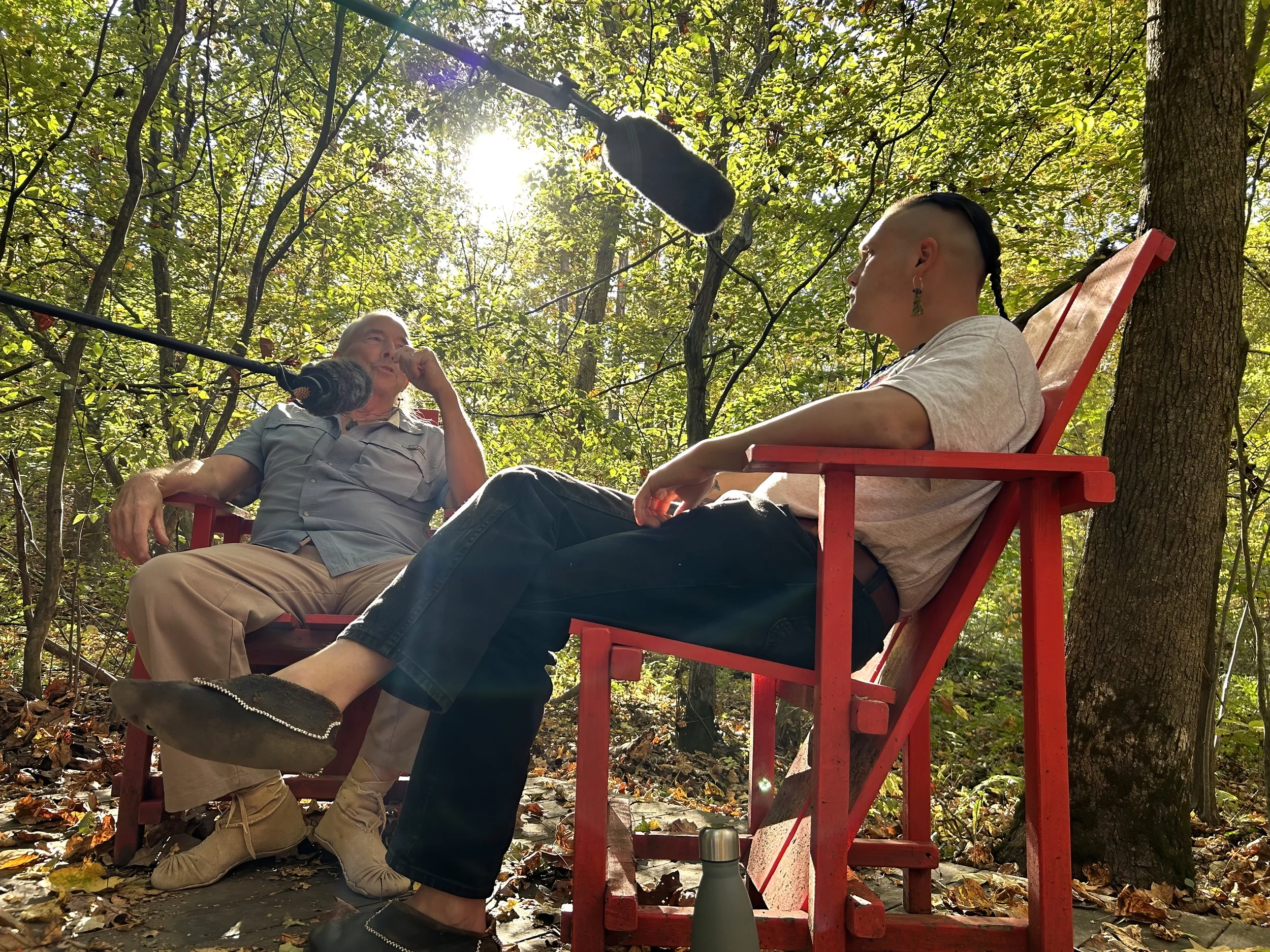
This episode was recorded on-site at Adkins Arboretum—the ancestral homelands of the Choptank people—featuring Daniel Firehawk Abbott (pictured left) and Drew Shuptar-Rayvis (pictured right).
Watch a video series where Daniel and Drew discuss the history and evolution of weaponry among the Eastern Woodland people
To learn more about the Pocomoke Indian Nation, visit their website at pocomokeindiannation.org.
To learn more about the Nanticoke and Choptank people on the Eastern Shore of Maryland, visit the Nause-Waiwash Band of Indians website, at turtletracks.org.
Credits
Chesapeake Homelands is a production of Beech Works. This episode was produced in partnership with Adkins Arboretum.
It was produced by George Burroughs and Lauren Giordano with additional recording by Ian MacAllister.
Special thanks to Daniel Firehawk Abbott, Drew Shuptar-Rayvis, and the Pocomoke Indian Nation Tribal Council.
This episode has been financed in part by Eastern Shore Heritage, Inc. with State funds from the Maryland Heritage Areas Authority, an instrumentality of the State of Maryland. However, project contents or opinions do not necessarily reflect the views or policies of the Maryland Heritage Areas Authority.