
Walking With Our Ancestors

-
This transcript was generated using a combination of speech recognition software and human transcribers, and may contain errors. Please check the corresponding audio before quoting in print.
(meditative music)
DREW SHUPTAR-RAYVIS/BLACK CORN: Natadawense Pekatawas MakataWai’U, Pocomoke renape naxpi lenu ne—I'm called Black Corn, Pocomoke person and man I am. My name is Drew Shuptar-Rayvis, that’s my English name. My traditional name is Black Corn. I'm a citizen and cultural ambassador of the Pocomoke Indian Nation. We are an Indigenous community to Maryland's Eastern Shore.Our traditional homelands are all the Somerset County, parts of Wicomico, parts of Worcester, parts of Lower Sussex County, Delaware, and parts of northern Accomack County, Virginia. Our subtribes are Gingoteague, the Quandacquan, the Manonoakin, the Morumsco, the Nuswattux, the Annemessex and Aquintica.
DANIEL ABBOTT/FIREHAWK: Ani tunt MahSquallen, I am the hawk that makes fire, tunt, fire, MahSquallen, hawk, a guide or teacher to our people. Abbott, Daniel Abbott, given name Firehawk or Hawk that makes fire. Adescendant of the Nanticoke-Choptank people of Maryland's Eastern Shore, and of course spreading out through intermarriage, trade, into what is now a vast part of Delaware.
Our people, in conjunction with many other tribes here on Delmarva prior to European contact, were probably the oldest chiefdom in the Chesapeake Bay region. Upon the arrival of colonial Europeans, the Piscataway Conoy chiefdom of Maryland's Western Shore mentioned to the English that before they formed their chiefdom, they had paid tribute to a much older chiefdom on, the east side of the Chesapeake. It’s possible, that the Powhatan chiefdom, also branched from either the Piscataway Conoy or the Nanticoke chiefdoms.
So most people don't realize that there were chiefdoms, all around the Chesapeake Bay region upon European arrival. Our people are still here today. We are all here today. The old adage of, kill the Indian and save a man did not hold. We are still very much Indian, if you will. And of course, we prefer Native American, or Indigenous American people, First People, if you will. We know that the last great paramount chief of the Nanticoke chiefdom was Nanticoke, in fact, upon European arrival here. But before that could easily have been Pocomoke at one time. But I think the ruling family was probably Nanticoke.
DREW: As far as we know, at least with Pocomoke people, we've always been separate. We've always been our own thing.
DANIEL: (muffled) Yes, separate.
DREW: And like we've we were allied with the Nanticoke, like at times. Same with like other groups at different times because we weren't as much as we as, as Native people like to say, “Oh, we're great warriors,” you know, “Oh we were great warriors,” we were not great warriors. We were we were farmers and fishermen, and we were hunters. But, you know, we had warriors. Yes, but we were not known for being great warriors. And so we needed—
DANIEL: Were known for being great traders.
DREW: Yeah. So but we needed bigger muscle. So we needed Nanticoke people to be our muscle.
DANIEL: (laughing)
DREW: We needed other tribes to help us out. I didn't know a lot about my culture growing up. My family really just didn't know who they were. And then I started actively doing my genealogy and kind of, you know, found out who I was, and researched that. But I was always interested in living history. I started when I was 19 years old. I'm 32 now, and living history provided me an avenue to participate in my culture, in my history, but also—it helped me to understand my ancestors and be as close to them as I possibly could by understanding their traditional modes of life through traditional skills, I could walk with them as closely as I could.
DANIEL: Indeed. Similar. I was, really well, not informed. Actually. My father, when I was very young, mentioned that we had native blood in the family, and of course I immediately went to my grandfather on my father's side because my mother's side are essentially Scotch-Irish from Philadelphia. So I said, Papa, I said, you know, God says we have native blood in the family. And my grandfather says, son, we've always known that we have native blood in the family. There was never been a question about that. I said to him, could you tell me something about them? You know, do you know who they were, or anything about them? And he said, no, I don't know anything else. I just know we have native blood. He didn't know who they were. He didn't know anything about them. He did say that my last words in that conversation were, we just don't talk about it much outside the family,
DREW: Yeah.
DANIEL: Because he was still being made to feel ashamed of having native blood, native ancestry. This was in the early 1970s, mid, early mid-1970s. The way it all started for me was through that, through knowing I had native blood. Since then, I found there's there's no doubt. And as the Nanticokes of Delaware are tracing their ancestry more and more, back in time. They're following their their migration up the Nanticoke into Delaware. And it's it's leading them further and further down the Nanticoke toward the bay, further back in time they go. So our peoples are definitely linked. There's no doubt Delaware recognizes its Nanticoke people, but Maryland does not. So we'll get there eventually. Maybe.
When I found my first artifacts, it was walking a beach as a boy, 7 or 8 years old. I remember finding that first crudely made cutting tool and wondering, you know, I mean, what was it used for?
DREW: Right.
DANIEL: How is it made? What is this glassy looking stone? And I wanted to know not just that it was—well, I thought they were all arrowheads back then—but that it was a tool made by Indian people. I wanted to know what it was made of. Where did this stuff come from? How did they make it? What did they use it for? And that got me started. First in collecting more and more and more artifacts and observing other people's collections and private and public collections and oh, gosh, over my lifetime, I've observed tens of thousands of artifacts from the Mid-Atlantic and beyond—but it gives me a good base of reference. And then I had to learn where to get the material, how to process it, to get the materials, to make the tools, how to make the tools in the traditional ways. And then how were these tools utilized and how many purposes could they be put to, to do things, and not just one thing went to another. And from making stone tools, I went to fire making. I went to fiber technologies. I went to prehistoric pottery because each thing you learn allows you to broaden your horizons tremendously.
DREW: Connects the dots.
DANIEL: It does, it does. And then eventually I built prehistoric houses. I've built three in my life. Museum quality, I like to add, because a lot of prehistoric houses aren't museum quality, and staying in them for extended periods of time.
By the way, I'm 73 years of age. I was born and raised in Dorchester County in Maryland's Eastern Shore, on the ancestral hunting lands of my father's ancestors. My father's people are Chesapeake Bay watermen and trappers, and they still reside principally in lower Dorchester and, on the Pine Islands and the and the vast marshlands. So we never left our ancestral lands. And by the late 16—early 1700s, our leaders were fed up with, English encroachment on our hunting lands and stealing and conflict and all of that good stuff and their livestock rooting up our gardens. So we decided to take the, the Shawano—the Shawnee and the Iroquois up on their invitation to join them up north. And we made a series of migrations with the remnants of Powhatan peoples, Piscataway, Conway peoples, others here in the Mid-Atlantic region to join the Iroquois and the Shawnee, as I said. But there were always those who were too old, too young, to sickly to make their journey. And like many other native groups of people, not all of us move away. Not all of us die and go away. We stay on our ancestral lands.
In our case, we move into the marshlands of the lower shore and we develop isolated communities. Reside on the land that the English are not interested in. They want the high, well-drained land to grow tobacco, you see? So ‘if those savages want to move into the marshlands and take up residence on those godforsaken mosquito fly ridden islands, well, we're better rid of them’, of course, but we continue to do quite well as we always had to work the water, trap the marshes, hunt the forests and these isolated communities did quite well. Of course, marriage partners were in short supply. So my grandfather often said it wasn't uncommon for second and third cousins, sometimes first cousins to marry. And I like to add sometimes that's maybe why we're a little screwy in the head. But, who knows? Regardless, I got into interpretation through, this research that I had been doing on my own for a long period of time, and bits and pieces here and there, not much was known.
I was fortunate because I grew up in the ’50s and ’60s and the great resurgence of, of prehistoric or primitive technology was in the early to mid ’70s. I was living in Virginia during the ’80s, and it was in full swing at that time. And I just happened to move to Roanoke, Virginia, where about 45 minutes away in Lynchburg, Virginia, the man who started this great resurgence in prehistoric native technology in North America lived. His name was Doctor Errett Callahan. And I became one of his students. And so he carried me to great heights with what I had already been practicing. And that is principally flint working. At the time, I had done a little bit of bow and arrow, but he took me to a much, much greater levels. And also in prehistoric, pottery and and lodge building. He was my primary consultant, for the first lodge that I built, in Roanoke at the Virginia Explorer Park.
DREW: It's really funny that you mentioned Callahan, because I was really influenced by the Society of Primitive Technology and the Ancestral Skills Book and Callahan, that was all doing those things in the early ’80s to like the mid to late ’90s, you know, and I grew up as a teenager, starting with ancestral skills.
DANIEL: Yes.
DREW: And really learning those. And I remember I had one of Callahan’s bow building posters.
DANIEL: Sure.
DREW: And I had one of my Christmas gifts one year was that book of Ancestral Skills book.
DANIEL: Yep.
DREW: You know, and so, Callahan—
DANIEL: That those the Ancestral Skills 1 and 2 came from the first 12 volumes.
DREW: Yeah.
DANIEL: Of, the society's bulletin.
DREW: Yeah.
DANIEL: And, I lost those in a fire, unfortunately. But they, they gave me the everything that I lost, they they were replaced free of charge.
DREW: Now, I wonder too, if some of that, like Callahan was it offshoots of the back to the land movement of the 1960s that kind of made people then.
DANIEL: No.
DREW: So it was always its own anthropological, archeological separate thing.
DANIEL: Indeed. Callahan saw, his degree was in anthropology with, I think an emphasis on Native American archeology. And when he did his PhD thesis, he, his thesis was on constructing and recreating a Pamunkey Indian Village. So he really started interacting intimately with the Pamunkey Native People, who were the core of the Powhatan chiefdom. And he started practicing these prehistoric life skills. It was all experimental archeology, and some things were known through, oral history. There were still people out there who were dabbling in it, but he took it and refined it. Okay. And if materials were available to our ancestors, then the way you use these materials in recreating the tools by studying the original artifacts through archeological research, then he started doing this experimental archeology and developing this full scale Pamunkey Village. And through it you had, prehistoric pottery being manufactured, flint working, making the tools, using the tools to construct the houses, cooking techniques, hunting, fishing techniques, plant-animal fibers, heirloom native crops being grown and utilized, food preservation techniques, friction-fire making skills. All of these things came to the forefront through this Pamunkey Village project. I met him in the late ’80s early ’90s and took his workshops. He kept incredibly intricate records.
DREW: Yeah,
DANIEL: For all this stuff. Yeah. And in fact, you can go to the Pamunkey Reservation today on the Pamunkey River in eastern, Virginia there. And many of the tools that you'll see in that museum are from the Pamunkey Village project—Callahan’s—and the tools Pamunkey’s learned to make—
DREW: I think though, for a lot of us, like Callahan, was one of these people that really started a lot of things.
DANIEL: He did.
DREW: I know I, I've read a lot of those and got super excited and inspired and, you know, and I think what progressed there with me was that I really got, you know, because so much of my history begins at the Colonial period. And I got I really wanted to learn more. And then, of course, at 14, I saw 1992’s Last of the Mohicans, and I was done.
DANIEL: (laughing)
DREW: I was done. As a kid you couldn't have convinced me, you know. And I wanted to make a breech cloth and leggings
DANIEL: Oh sure.
DREW: And I wanted to do the whole thing. And my first breech cloth and leggings came from an old woolen coat. And I took the arms out of that coat and made leggings and cut out the center part of the coat made a breech cloth. And I thought, I look so cool. I look back now in horror, but—
DANIEL: (laughing) Yeah the old photographs.
DREW: But but then, you know, but that's what inspired me. And I remember my mother making my first pair of moccasins, you know, and helping me make my first pair of moccasins. And then I taught myself how to make them. And now I'm at this point now where I just use my hands. I don't use any cutouts. I do everything with my hands and my fingers, just as my ancestors would have done measuring my feet with my hands and my fingers.
DANIEL: Sure, with lengths of cordage or whatever.
DREW: Yep. And just, you know, doing these things. So, you know, I think for me, that's what's kind of spiraled into the Colonial period where I started out being pre-contact and really being really interested with the friction-fire, flint knapping. And I still flint knap, I still I've my I don't do as much, but I do mostly pressure flaking is making arrowheads and making small things, making a lot of soapstone objects. But, you know, I think it progressed with me into that Colonial sphere. And I got really interested in kind of my focus now in my 30s is the middle 17th century in the southern Mid-Atlantic. And that's kind of really been my big focus is like material culture of Eastern Woodland people in the southern Mid-Atlantic and from between 1640 to 1690.
DANIEL: It’s our ancestor.
DREW: Yeah, that's it's literally where you and I begin,
DANIEL: Absolutely, it is.
DREW: Like, as human beings, yes.
DANIEL: That’s where we start, you know? So it's one of those things that I think, you know, is really important. I think interpreting has really humbled myself a lot because you realize, like, you dress, you know, I'll do winter encampments and I'll do like 18th century winter encampments in like, New Hampshire and like to wear a breech cloth and leggings and boot moccasins and 20 degrees will humble you.
DREW: And you have to imagine,
DANIEL: True test.
DREW: I had ancestors who did this for thousands of years and like, they didn't have this insulation that I had. They didn't have the central air, central heating, central cooling.
DANIEL: No.
DREW: I'm so blessed. I'm so blessed. And I'm not only that, but I'm so blessed to be doing what I'm doing, knowing that my great-great grandparents did not have the opportunity to be open and proud about their history and culture, that they didn't have the opportunity to do what we're doing
DANIEL: Same.
DREW: And that they smile—they must be smiling knowing that we are so vocal. We're doing this right now with these microphones and that we're talking about this history and our culture, and that we're so proud of this. We're no longer ashamed of it.
DANIEL: Very much so.
DREW: But, you know, but I think it's really humbled me a lot that there’s—a I'm always a student. I will forever be a student.You know, one thing you'll learn, and I think you could agree that you'll never be a master. No one will ever be a master.
DANIEL: Oh no, no.
DREW: You’ll always be a student.
DANIEL: I tell people in my presentations that I've been doing this since about late ’80s I've been doing these presentations and learning new things along the way, and I never stop learning. And I have people that come up all the time and, oh, you're such an expert, you know that just demonstrating and doing these things. And I say—no.
DREW: Drew
Yeah, you have to.
DANIEL: No. I'm no expert though.
DREW: Right, exactly.
DANIEL: 40 plus years of doing these things in my life of researching, of practicing the the ancient life skills of my ancestors, I barely, barely touched the surface of what they knew.
DREW: Well, wasn’t it Socrates who said: I know that I know nothing.
DANIEL: The more you know, the less you know.
DREW: Right, you know. But it’s very true as as I've gotten older, it's like, I know that I know nothing.
DANIEL: Yeah.
DREW: You know, and it's just interpreting is very much humbled me and humbled me that in the sense that like, look how far we've come and look at the luxuries that I have just at a fingertip.
DANIEL: Oh, indeed.
DREW: You know, and that, like, you know, these skills required so much patience and so much time and so much artistry and so much beauty have, you know.
DANIEL: And it's therapy.
DREW: Um-hum.
DANIEL: And were you going out into the natural world and knowing what to harvest, when to harvest it. So it's how do it's best to process and serve you. Because the creator told us.
DREW: Yeah.
DANIEL: You know the creator said I place you here on this great Turtle Island. I give you dominion over it. All that you see before you is here to make your life bountiful. It's here for you as long as you remember one thing. And this is most important, for if you break it, it will be taken from you. And that is, you must always respect what is given to you. And so the land had changed, very little in terms of thousands of years of our being here, as a result of that promise. Europeans chose to conquer the land and profit from it until it's gone. Then they move somewhere else and do the same thing until welcome to the modern world.
DREW: Right.
DANIEL: There’s no place left to go. But this is therapy. Like even here, coming out here. Oh, by the way, we haven't mentioned, of course, we're at the Adkins Arboretum today. Sitting in the middle of the forest, a beautiful location on a platform here with, wonderful kind of Adirondack kind of style chairs.
DREW: Homelands of the Choptank People who are the Nause-Waiwash Band of Indians.
DANIEL: Indeed, our group of people
DREW: That’s who they are the direct descendants of.
DANIEL: Here on the upper Tuckahoe Creek, which is a branch along with the Marshy Hope, is a branch of the Choptank River, just north of the Nanticoke River, next watershed up. Choptank is the border, the county border between Talbot or over here, it’s “Tall-but” and Dorchester counties. This is a different world, I have to say. Well, the upper-shore, it's a totally different world.
DREW: Well, the upper shore is so different than the lower shore. Like it really is. Even just the forests and the landscape is just, like compare this the upper shore with like let's say where Raccoon Point is in Somerset County.
DANIEL: Um-hum.
DREW: Like it's just, it's just so night and day different, just even the forest structure. This forest structure—so I grew up away from the homelands. I grew up in northwestern Connecticut. Just by circumstance. My father was living there. My father's from Philadelphia and my mother was in school in Philadelphia. My mother became pregnant. My father took her to where he was living in western Connecticut, and I just happened to be born there. First of my family, not to be born, I and my first cousins, not to be born in the southern Mid-Atlantic in 300 plus years.
So like even this forest structure is very similar to what I grew up in, in western Connecticut. This is very, very similar to the lowlands in between hills like, you know, with all the Ironwood that surrounds us, which of course my thought is making bows and making clubs because that's what Ironwood is really good for.
DANIEL: Oh yeah. Yeah. People get that Ironwood confused with Blue Beech oftentimes.
DREW: Yeah. No it’s not the same.
DANIEL: Ironwood, American Hop-hornbeam people, that's Ironwood. Yeah. So here we are at Adkins Arboretum, by the way, in case you didn’t know, it's right next to, Tuckahoe State Park on, Delmarva Peninsula. And we're nearing, we're not actually on the spine of the Eastern Shore, what's called a spine, which is the highest elevation, which is what, 20ft above sea level, or something like that?
DREW: Is it, Handsell? I was told that Handsell is one of the highest points in, like, Dorchester County.
DANIEL: Yeah, and Handsell is only about maybe 40ft above sea level.
DREW: Yeah.
DANIEL: I think the average here on the lower shore is probably going to be 2 to 3ft above sea level.
DREW: Yeah.
DANIEL: And then the marshlands one foot above sea level.
DREW: Yeah.
DANIEL: So it's a very unique environment. Have you always been the proverbial Mother Nature’s son though?
DREW: Yeah, I would say so.
DANIEL: Yeah. I mean, from the time I was, you know, knee high to a grasshopper, as they say, I was always out in nature. I even before I knew we had Native ancestry, I knew, in fact, I was standing on the beach one day on the Choptank River, and I was only about maybe 8 or 9 years old. My mom had just started letting me ride the bike down to the beach. You could still go on the beaches back then. So I was just standing on the beach, and I remember looking out across the river and all of a sudden there was like a wave that came across the river and it was visible. It was like, you know, how you look down the road and the hottest of the summer months—
DREW: Yeah.
DANIEL: And you see—
DREW: The wavy—
DANIEL:—the waves coming up off the road,
DREW: Yeah.
DANIEL: It was like that. It was like a band that came across the Choptank, and it went right through me. And I never could explain what it was. And later, as I started doing more research and understanding more about Native spirituality, I now know what that was. It was the life force.
DREW: Yeah.
DANIEL: And it was it was moving through everything. And I asked people in a presentation how do you see God? How do you explain God?
DREW: God is everywhere.
DANIEL: What is God to you? And do you know not very many people have ever been able to answer that question. Yeah. What is God? And is God some old white guy up there on a cloud, you know. And that's that’s—right? Maybe that's that's for you to determine.
DREW: Yeah.
DANIEL: But, you know, for us it's that which moves through all things in the universe, and binds all things together. It's that which gives and receives all things and it's that, that force that pervades everything in this universe. And we live it. We live by that force. We feel that force. We are one with that force and with the spirits of our ancestors that still walk this land.
DREW: Yeah.
DANIEL: Oh, I feel I'm emotion welling up in me right now. But I look around this forest and I know the spirit is still here. Because they still walk this land and they always will. And I will, too, someday. After I go up and spend, you know, a while, around the campfires of my ancestors up there in the night sky, that's what stars are to us. I'd like to bring out to how I got really involved in interpretation. Because I wasn't initially, I knew I had Native ancestry. I knew nothing about it. I got my start recreating Rocky Mountain Man clothing.
DREW: That's how a lot of people, a lot. Listen, no, a lot of the older people—
DANIEL: That’s all we knew,
DREW: —but a lot of the older people that I've met, you know, people who like you, I would go as far as saying also Nana-Pash-Met of the the Wampanoag. Yeah. And a bunch of others, Roger Sheehan of the chief of the Elnu Abenaki who really got, after post 1976, a lot of the rendezvous scene. I can't remember how many older people I've met—
DANIEL: And the powwow scene
DREW: Who were in the powwow, and rendezvous scene. Yeah.
DANIEL: And even here in the eastern part of North America.
DREW: And they told me that, and they said that's all there was at that time. You know.
DANIEL: We lost our culture so quickly. We're first contact people with Europeans. You know, we've been in contact with the Europeans since the early 1500s.
DREW: Right.
DANIEL: Here along the Atlantic coast.
DREW: Absolutely.
DANIEL: So, you know, people out inland, further west, much later, contact. Now, people don't realize, I think oftentimes that those Appalachians were the great wilderness up until, what, 1700s, right? Even even in the middle.
DREW: Middle to late 1700.
DANIEL: Absolutely. By that time, we're pretty well decimated here on the Atlantic coastal margin. Most people don't realize as well that a hundred years of intermittent trade with Europeans, roughly speaking, in the 1500s, throughout the 1500s, prior to the arrival of the English at Jamestown in 1607. Say 100 years of intermittent trade from Canada to the Gulf of Mexico. It's now estimated that 50 to 60% of the total native population of the entire Atlantic seaboard had been decimated, wiped out by the time the English arrive at Jamestown. And that's from Canada to the Gulf of Mexico and inland to the Appalachians right now, due to epidemics that they brought with them. So we had been weakened terribly already. And that continues as the colonies expand, European colonies expand and move westward. So we lose touch with our traditional life ways.
DREW: Right.
DANIEL: Very quickly because of European diseases, in addition to starvation, skirmishing, and wars, actually with Europeans. But again, most people don't realize that 95 to 97% of the 50 to 60 million Native people, estimated population of North American Europeans start to arrive here is decimated by European disease, not warfare.
DREW: Right.
DANIEL: Only 1 to 2%.
DREW: Right.
DANIEL: But who goes first? Again, your very young. Your very old. So we lose the next generation. We lose the ability to teach them. Okay, first.
DREW: And so it becomes more necessary to adopt things like firearms, things to adopt iron axes. Because who's going to teach you to make those things? Who's going to teach you to make that bow? If there's no one to teach you, exactly who's going to teach you to make that ax? If you don't make that ax.
DANIEL: I’m going to go back, come full cycle here. And we were talking about powwows, festivals and—
DREW: The old rendezvous.
DANIEL: Yeah, the old rendezvous. And what you see primarily up and into like the, the last decade even, you see Western Native culture exemplified. You don't see Eastern Native culture because of this losing touch with our culture so rapidly and very early on, you see, the Western cultures were contacted very much later, you know, 17-1800s. So they've maintained closer contact with their traditions.
DREW: Right.
DANIEL: As a result. And so now the Eastern people are borrowing from the Western culture, thinking that, well, somehow it's like their culture, but people fail to realize Native people were extremely diverse people.
DREW: Yeah. Very regional.
DANIEL: And if you had traveled 50-75 miles from your birthplace during your lifetime.
DREW: You had traveled far.
DANIEL: Prior to the 20th century, 20th century travel is essentially unknown and before the 20th century, unless you're a diplomat or trader, you wouldn't have traveled very far in your life. So as a result, depending on the climate you live in, whether that's north, south, east, west or in elevation, that shaped your culture, and just one or two watersheds away rivers, you could have people speaking different dialects of the same language, living slightly different lifestyles, tattooing slightly different, painting slightly differently, decorating slightly differently. And we knew each other, and we had no trouble communicating with one another. People don't realize as well that there were universal languages of trade, not just sign language.
DREW: But trade dialects, specific dialects.
DANIEL: Spoken dialects, and that we have a written language. But it disappeared so rapidly here people forgot how to interpret the glyphs. The pictograph language that we had at one time throughout the myriad of travel and and trade pathways by land and water, there were locations where people could stop and carved into the bark or painted into into the bark of trees or carved into stone. You could read who had passed, how many, what their purpose was, where they were going, and when they'd be returning. It's just that the cultures were lost so rapidly, and it's only recently now that people have started doing in-depth research and reviving the life ways of our ancestors, that some of the Eastern aspects of Native culture in North America are now returning. Right. And we're seeing more and more of it, which—
DREW: Correct me, as one of my elders, like, correct me if I'm wrong—so what I was taught was that we in the East had lost so much—and this is going back to the early 20th century—that we had lost so much that the Western Indians felt bad that we lost this. And this was during the time, like the Buffalo Bill shows, and that when they came here, they felt really bad. And that's when they gifted us things like the headdress. They gifted us things like the plains-style pipes. That was because they wanted to give us something. And that's when you see this, like revival of the powwows. Not for every community. There's some communities that have maintained stuff like that for a very long time. But I'm saying for like a lot of different communities that that's when you see this rise in like the late 1800s, really early 20th century.
Now, is that on point? I mean, I’ve heard that before.
DANIEL: Oh yes, that's definitely a part of everything that was going on throughout all of this transition back to our traditional ways.
DREW: Because that's why, you see, like our old chiefs with the Plains headdresses now. Yeah, because they were that's what they were given. They were given this from the Plains people because we.
DANIEL: Didn't we didn't know until people started doing more in-depth research and putting together the pieces of the puzzle. That's what I've been doing for 40 plus years of my life at least. I've been studying cultures surrounding the Mid-Atlantic region, as well as, because there were so little recorded in the Mid-Atlantic region, about our people. But by looking at cultures that flank our hunting lands, our traditional region where we lived, I've been able to glean different aspects, knowing that we lived in matriarchal, matrilineal cultures, that we—men and women were equals. We lived in a veritable paradise.
DREW: Right.
DANIEL: I tell people and they're just amazed, at what the land was like here. Well, this is nothing. Today we are looking at matchsticks. Today here at, the Arboretum.
DREW: Yeah, there's.
DANIEL: It’s still a nice forest, but it's a secondary forest.
DREW: And, there’s similarities. And I would definitely say that there are elements that would have been recognizable 400 years ago. But one of the things that you read about in Dutch and in English records, because sometimes you have to go beyond the English records and you have to go to Dutch records because the Dutch is explored so many other places and had connections all the way down into the Chesapeake, we know we find their trade objects there. And the Dutch would say, too, that there were trees that were four, five feet in diameter.
DANIEL: Oh, easily,
DREW: You know, and that these trees were just massive.
DANIEL: Yeah.
DREW: You know, and I just well—what would you do if you just saw a whole stand of trees that were five feet in diameter?
DANIEL: Well, yeah, I'd say yeah.
DREW: 200ft tall. 100ft tall.
DANIEL: Oh. They just found, bald cypress in Blackwater Swamp.
DREW: In North Carolina?DANIEL: Surry County, Virginia.
DREW: Virginia. Yeah, I heard about that.
DANIEL: 26ft in circumference.
DREW: Wow.
DANIEL: It managed to escape all these years. 400 years, 26ft. Well, divide by pi, (muffled) that’s almost nine feet across. That's a—and the two men, had pictures taken with them standing at the base of this one bald cypress dwarfed them. It’s, they're just dwarfed. It's stated that many of the trees in these Eastern forests of North America were so huge that four men holding hands and arms outstretched, could not get around the trunks of the trees. Trees that were 80 to 150ft over your head, with leaf canopies so thick. This is nothing
DREW: Block out the sun.
DANIEL: This is nothing, would literally blot out the light of the sun, so that plants under these great trees couldn't get enough light to really grow.
DREW: And then you see a whole other biome that develops, other like, so things like solomon seals and mayapples and lady slippers that need cool soil. That need shade all arise, which creates an entirely different biome, an entirely different ecosystem.
DANIEL: It would be a moist biome. It would be like twilight in the forest on the brightest, like today.
DREW: Today or middle of Summer.
DANIEL: Exactly at about 20-25 degrees cooler.
DREW: Yeah.
DANIEL: Which is why we didn't sleep on the damp forest floor. We slept on bed frames right? In domes, and we knew the strongest houses to build.
DREW: Right.
DANIEL: Domes and pyramids for most native houses. Cones, domes, and pyramids.
DREW: And ovals. Think of the longhouse
DANIEL: Domes and ovals. Yeah.
DREW: Yeah, domes and ovals. Because Iroquoian long house is an oval. And we had long wigwams.
DANIEL: We did, we did.
DREW: You know, that were oval shaped.
DANIEL: And round, as well.
DREW: And Penn even says there too, he says, you know their houses are like that of an English barn because it has to withstand the winds, you know. And so he's even saying that it's storm resistant.
DANIEL: Oh I built three of them. So I can tell you when we had the framework, for the lodge up for 2 to 3 inch saplings at the base, white oak, red cedar are the best because withstand rot in the ground. Contact a moisture in the ground, which is like an upside down basket, framework with the arches. And then you have the round stringers that go around the arches and bottom to top. And as you're putting them on, you're, of course, creating a ladder that you can climb. I had eight men on the top, 30ft long lodge of 14 wide and 11 tall, and that lodge did not sag an inch, not an inch.
DREW: Yeah.
DANIEL: Because all the weight on a dome is equally distributed all around, around the perimeter of the dome, so it can withstand tremendous weight. And, you know, snow in the winter, whatever, storms. Our ancestors never built rigid homes.
DREW: Right.
DANIEL: Rigid breaks. So you build a dome, there’s no flat sides for wind to strike.
DREW: Right.
DANIEL: It goes around, up and over. Two of my lodges have gone through hurricanes, plus three hurricanes and about an hour's maintenance afterward and right back in shape, ready to go.
DREW: Right.
DANIEL: Just like the day they were built.
DREW: That's another thing. You realize that our ancestors, you know, they were masters of physics. They were masters of aerodynamics. They were masters of chemistry, biology, thermodynamics.
DANIEL: They were.
DREW: So if you don't understand thermodynamic, you don't know how pottery is going to work. If you don't understand aerodynamics, you don't know how bow and arrow is going to work. You know, if you don't understand physics, the entire idea and concept of a wigwam or a long wigwam, like it would be foreign to you.DREW: You would have to, you have to master those things and conceptualize all those things to a fine discipline.
DANIEL: And pass it down generation by generation.
DREW: And to me, that's just so humbling and incredible.
DANIEL: Oh, it is.
DREW: That it's just like, wow, you know, to just and everything, one of the things I've realized too is that, you know, even seasonally, everything was so fine tuned down to the week, down to like the day that like—
DANIEL: The moment.
DREW: Yeah, that like this week is when we need to go and collect walnuts because this is going to be the peak of when they drop.
DREW: And harvesting the walnuts, and processing them, and dying the moccasins.
DANIEL: And rolling out the mats under the hickories and oaks to harvest the nuts.
DREW: Getting all the new new and moccasins and leggings. Because that's when you're going to die and you're going to take the hulls and you're going to either boil the hulls, you're going to rub the fresh hulls on to the moccasins and the leggings to darken them.
DANIEL: Archeologists find post mold patterns of the same design left the the ground stained darker. So you get this outline of what are called post mold or post hole patterns. And guess what? 10,000 years ago, the post hole patterns are the same as they were upon European contact,
DREW: Right.
DANIEL: When you find something that works, you stick with it, right? And you just make it better, better and better with each generation. So I ask people, you know, in these Hollywood movies, when Native people walk inside our lodges and you can see sunlight through the roof, Right? No, no, no, no, not even close. Our lodges were waterproof. They were highly insulated. Here we were building summer houses as well as winter houses right next to each other, in addition to work shelters, material storage. We even had, houses—ossuaries—for our dead.
DREW: Right.
DANIEL: You know, so there were different structures.
DREW: Right.
DANIEL: And they were all well built. They were built to withstand hurricanes that come off this Atlantic coast. And we didn't build right on the edge of the waterways. We built back from the waterways so that forest could protect us from the elements.
DREW: Exactly. Well, and modern science tells us that you know, these domed shapes, these oval shapes protect against, like, you know, they're aerodynamic.
DANIEL: They are.
DREW: That they are. This prism-like shape was is super strong. It was holds weight
DANIEL: It’s slightly flexible,
DREW: Yeah.
DANIEL: so it bends.
DREW: So it's all of these things that they mastered for thousands of years. Didn't have to go to a university. No college degree. Not putting that down. I have two different degrees from two different colleges and I'm proud that I went there. But it goes to show that, like, you could learn all this, master, all of these subjects without ever going into a Western style school.
DANIEL: Oh, yeah.
DREW: You know.
DANIEL: Oh yeah. Well, we have.
DREW: Yeah.
DANIEL: I mean, you don't learn these things in school, actually. You'll learn them through others who have learned from others, from others, from others.
DREW: And I think for myself is going through Western education.
DANIEL: Hands on.
DREW: You know, I think it’s well, I think I've been able to blend both because you can utilize elements of Western education and apply them to things our Algonkian ancestors did. And they're both compatible at points where you can then further understand what's going on, because you can understand the post mold structure, and you're understanding that through West, what we like to call Western methods of knowing, you know, utilizing those techniques and then saying, okay, if I apply this this way, this way, this way, you can further then understand.
DANIEL: If you rediscover something that works, guess what? Our ancestors, already know it.
DREW: Oh yeah,
DANIEL: We're not, we’re just reviving it. We're not learning, we’re not discovering anything. Really.
DREW: Some pottery needs temper, some does not.
DANIEL: Yep. We barely, barely touched the surface and all that we know and all that we've experimented with and and passed to others, and that's very important. We have to pass this on, like me to you as you said, and you to others in the next generation. And keep this moving. Keep it expanding, keep it, keep this revival going. And and it doesn't matter whether you're Native or non-Native.
DREW: Um-hum. Exactly.
DANIEL: That is not what's important. What is important is that our traditional life ways are carried forward.DREW: Right.
DANIEL: Our beliefs are carried forward, whether it's solely among our own people or if it's adopted by others.
DREW: Right.
DANIEL: That's wonderful. The story is still being told.
DREW: Guys like you, Daniel, but like Roger Sheehan, Nana-Pash-Met, you paved the way to do what I'm doing now. You really did.
DANIEL: Well, thank you for saying so nephew.
DREW: You paved because like, you were all there in the ’70s, in the ’80s, really paving the way for this kind of interpretation. And I thank you for it because like, again, again, how humbled and blessed I am. I have it easy. You had to look in your library for books. I can go on the internet and find stuff.
DANIEL: Ah, I supposed that’s true.
DREW: I have the world's knowledge at my fingertips. You did all of these things utilizing what you could find at your county, local, state library. And that's amazing. You know, I think I think for us, you know, interpreting is a way to reconnect with a culture that was taken from us, and it's a way to remember and a way to honor, you know, who we are, what we are, and to pass something. Pass something forward. Pass something on.
DANIEL: Absolutely.
DREW: You know, I can't tell you how proud I have been to, like, show people how to make mocs like moccasins.
DANIEL: Oh yeah, yeah, sure.
DREW: Show people how to make something, you know, and like, go through them and show them you're passing that on. You know, going with my niece and nephew and I'll give them a few words here and there and I’ll—
DANIEL: What better way to reconnect people to the land than to give them a purpose for interacting with the land, not just going out and walking a trail. Not just birdwatching, but to actually learn edibles, medicinals, utilitarian materials that you can harvest with reverence. All right. And only as much as you need. Right? And do it under supervision. Which is the safest way to do it. Then you connect again, you connect through that. It's a true connection. Whereas these other things are just, you know, fleeting. And I think often time well, there is a connection there, I'm sure. But if you actually eat it, cure yourself with it, if you're not feeling well. You make tools that serve you. They function beautifully. Then you're really developing a connection. And it's easy to understand now that we've done these things, how our ancestors felt about this land,
DREW: Absolutely.
DANIEL: How intimately connected they were to it.
DREW: You understand that it's a living, breathing, conscious thing.
DANIEL: It is.
DREW: That it's as much awake and alive as you are.
DANIEL: And.
DREW: And that it knows who you are. It knows who you are before you knew who you were, you know. And so it is a powerful feeling to be in these homelands and to reconnect with these homelands, whether you were born on them or if you were removed by not even by your own choice. You know, and we're born in other places, it's it's important to know that. And I think by learning these skills and learning these things, we can understand the, you know, we can understand that we were living and that we still do in a living and conscious place that this world, these plants are our relatives, the animals are our relatives, the stones in the water, all of it's related to us and a part of us.
(meditative music)
DREW: To learn more about the Pocomoke Indian Nation, visit their website at pocomokeindiannation.org. To learn more about the Nanticoke and Choptank people on the Eastern Shore of Maryland, visit the Nause-Waiwash Band of Indians website, at turtletracks.org. Links are also available in the show notes.
Chesapeake Homelands is a production of Beech Works.
This episode was produced in partnership with Adkins Arboretum, and recorded on-site at the Arboretum—the ancestral homelands of the Choptank people—featuring Daniel Firehawk Abbott and Drew Shuptar-Rayvis, whose traditional name is Black Corn.
It was produced by George Burroughs and Lauren Giordano with additional recording by Ian MacAllister.
This episode has been financed in part by Eastern Shore Heritage, Inc. with State funds from the Maryland Heritage Areas Authority, an instrumentality of the State of Maryland. However, project contents or opinions do not necessarily reflect the views or policies of the Maryland Heritage Areas Authority.
Visiting on the homelands of the Choptank people, Daniel Firehawk Abbott, a descendant of the Nanticoke and Choptank people and Drew Shuptar-Rayvis (traditional name: Black Corn), citizen and cultural ambassador of the Pocomoke Indian Nation discuss the early history of Maryland’s Eastern Shore, and what led each of them to work in interpretation. Listen to part 2 of this conversation here.
Learn More
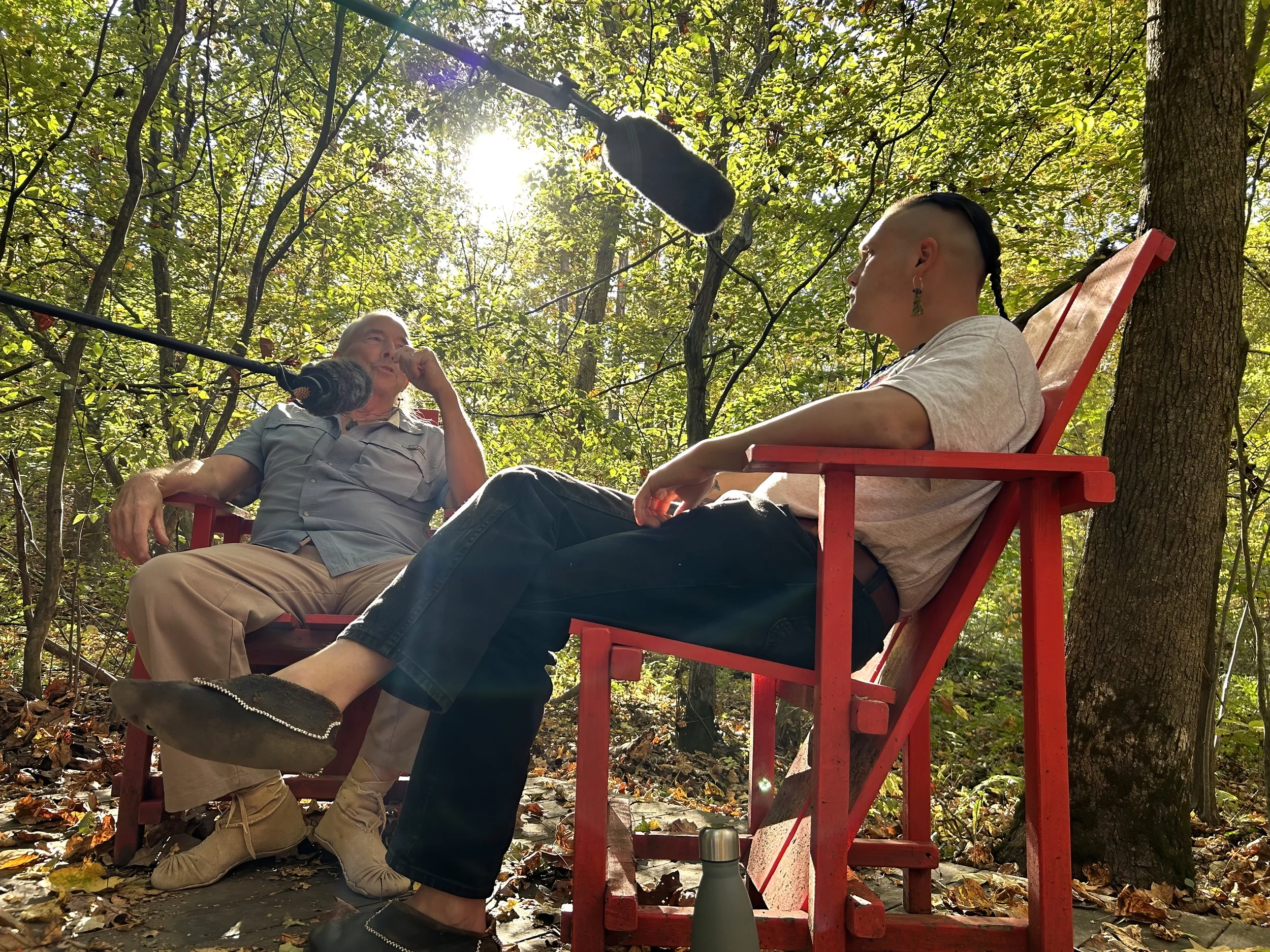
This episode was recorded on-site at Adkins Arboretum—the ancestral homelands of the Choptank people—featuring Daniel Firehawk Abbott (pictured left) and Drew Shuptar-Rayvis (pictured right).
Watch a video series where Daniel and Drew discuss the history and evolution of weaponry among the Eastern Woodland people.
To learn more about the Pocomoke Indian Nation, visit their website at pocomokeindiannation.org.
To learn more about the Nanticoke and Choptank people on the Eastern Shore of Maryland, visit the Nause-Waiwash Band of Indians website, at turtletracks.org.
Credits
Chesapeake Homelands is a production of Beech Works. This episode was produced in partnership with Adkins Arboretum.
It was produced by George Burroughs and Lauren Giordano with additional recording by Ian MacAllister.
Special thanks to Daniel Firehawk Abbott, Drew Shuptar-Rayvis, and the Pocomoke Indian Nation Tribal Council.
This episode has been financed in part by Eastern Shore Heritage, Inc. with State funds from the Maryland Heritage Areas Authority, an instrumentality of the State of Maryland. However, project contents or opinions do not necessarily reflect the views or policies of the Maryland Heritage Areas Authority.